I have a year remaining of my funding, and my University expects my thesis to be submitted no later than a year after that date.
It is truly crunch time. Which is terrifying and exciting, because it means there is light at the end of the tunnel. It also means, for the first time, I feel a sense of urgency and worry about getting all the writing done in time.
So I’m saying it here on the internet: My goal is to submit my thesis by June 30th, 2027.
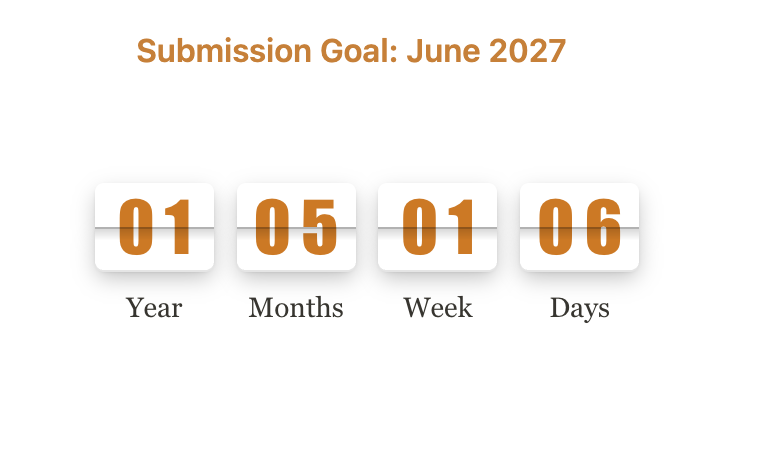
So I started writing this post at the beginning of this year and then for some reason or another, didn’t finish writing (the post) whoops. I have, however, continued writing the thesis! I may write another blog post which gets into the thesis writing, but I wanted to discuss for the record, how I am managing to work full-time (compressed hours at Glitch) and also write my thesis as a part-time PhD candidate. TL;DR: she’s tired.
Scheduling
In Q1 of 2026 I requested moving to a flexible working pattern to my Board. Glitch has a four-day work week as our full-time week (with no adjustment/pro-rata of salary), which is 32 hours. Before finalising the flex working plan, I trialled a variety of working patterns, but landed on compressing my hours over three days, Monday to Wednesday. This works for me because it means I have Thursday, Friday and Saturday to work on the thesis. It does mean, however, that I work 11 hour days on my day job in order to make it happen. On PhD days, I aim to be at my desk by 8am, and try to finish up around 5. Sometimes that doesn’t always happen, though, and I will start PhDing later, take a break, and then work until 8 or 9pm. This happens especially after I’ve been travelling for work or if I’m very tapped out.
After nine months of this pattern, I am exhausted, but it is a functional schedule. Unfortunately, there is no alternative pattern of working I do if I want to complete the thesis next year. Trust me, I have thought many a time about taking an interruption to my studies; or, working early mornings and in the evening; or returning to the normal four-day work week. But all of these options only extend the timeline for when my thesis is due, and thus how much longer I have to juggle two pretty massive intensive jobs. The approach I am currently taking is the best for the objective: complete and submit my thesis in 2027.
However, there is one thing I should have done sooner:
- Ensuring I take a full weekend (i.e., not working across Friday and Saturday) every five to seven weeks!!
The working pattern of Glitch/thesis writing, means I work six days a week, with Sunday as my day to prepare for the week ahead. Although I am accustomed to working full-time while studying (I did my MA full-time and worked full-time), this is the first time I have held the role of Executive at Glitch while doing so (since 2024(!)). Both of my jobs require heavy thinking, reading and strategy work, and being the ED at Glitch comes with additional pressures and a heaving travel schedule. All of this is mentally taxing, so rest from using my brain is necessary (not to mention to keep my long COVID at bay…but I have discussed this elsewhere).
A weekend off every seven weeks does not allow me to fully minimise burnout symptoms (to state the obvious), but having a weekend to do whatever I feel like does provide some reprieve from feeling like a scrunched up piece of paper that has been trodden on and then set on fire :).
Writing the thesis
Actually sitting down to write up the work I began in 2021 was a very scary feeling — it felt like beginning an open book test, in that I knew I had prepared, but I was so nervous, but I knew I had all of the resources to help me through it. Basically, do I actually know what I am talking about? Have a created new knowledge? Do I know my epistemological and my ontological groundings???
To help me with grappling with the overwhelm that is needing to write around 10-14K words for eight chapters, I break down each chapter into preparation, writing, and then editing.
The preparation takes the longest amount of time. First, I read through all of the literature I think I will need (or want to) engage with in the chapter. Then, I create an outline, using bullet points to structure the overall argument and sections. After, and I find this the hardest part, (because sometimes I am unsure of the structure of a chapter until I am halfway through writing it) I will try and write topic sentences for each of the bullet points/sections. Finally, I write ‘tiny texts’, which are ‘abstracts. Storyboards. Story threads. Lines of argument.’1 Tiny texts are short summaries of each paragraph in the outline. I find this tremendously helpful, because it requires me to think about what it is I am actually intending to say, which is ‘a way of capturing extended thinking.’2 It forces me to do the intellectual work required to get organised for writing.
To support this multi-stage preparation process, I use my detailed reading and annotating matrix in Notion.
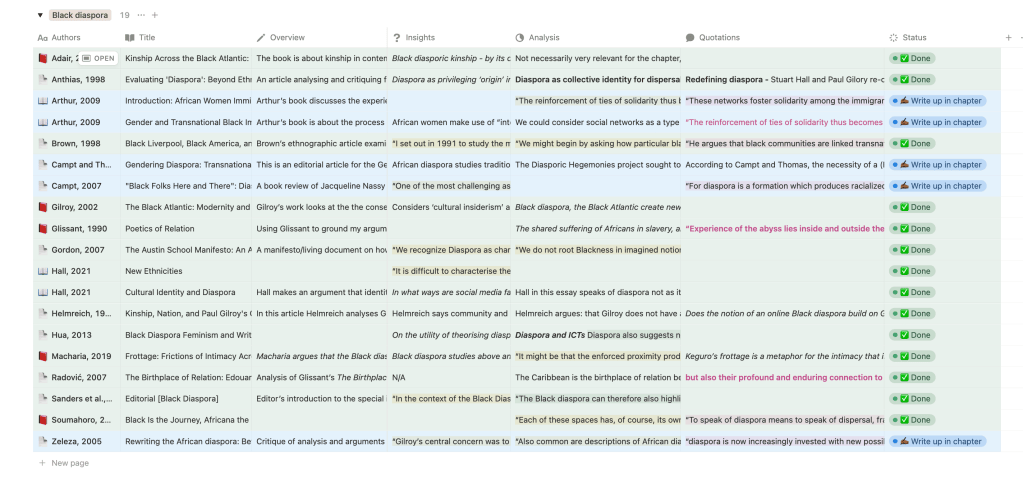
Once I’ve finished reading and annotating the literature, I export this into a table in Word.
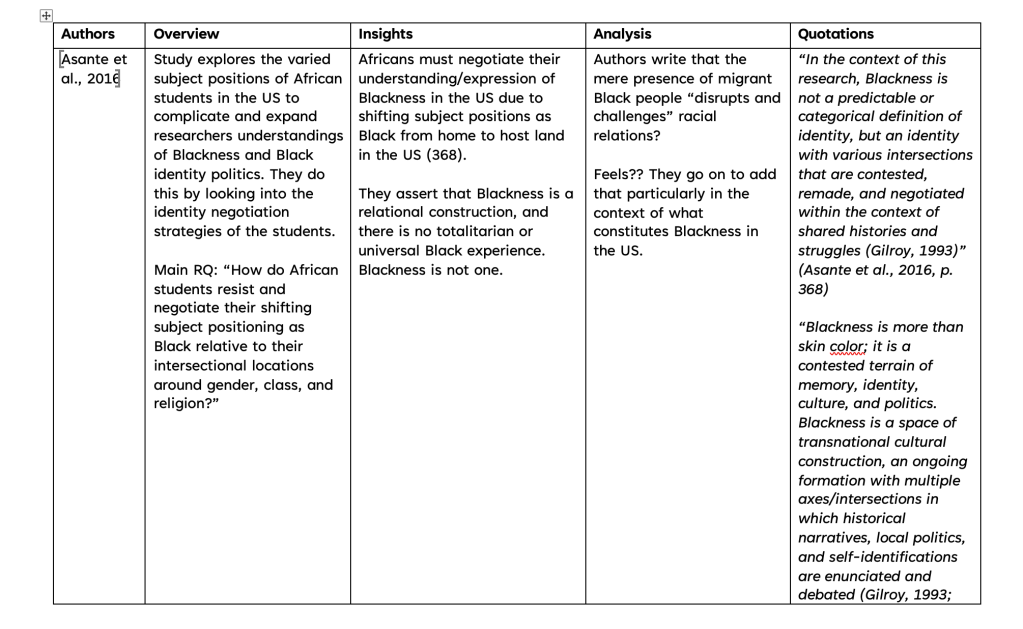
Then, I open a new draft document, and using the tiny texts and literature annotations from my outline…I begin writing.
If this seems like a lot of work, that’s because it is. I have realised that this is just how my brain operates. It’s the only way I feel I am able to get my head around and through all of the literature (and eventually data) I need to write a chapter. And it works!
Since I began ‘officially’ writing the chapters of my thesis on July 9th, I have written around 25K words in 35 working days.
Because I only have three days in a week to write, this means I have a limited amount of actual working days. I wanted to understand my work rate, and (also have pretty graphs :). So I tracked the days I can expect to write. This also helps me plan my schedule in advance! So far, I have a full draft of my methodology chapter, and just last week I submitted my draft conceptual framework chapter to my supervisors. What this means is that I have my three empirical chapters left, and then it’s just introduction and conclusion, bish, bash, bosh. Eeeeek!
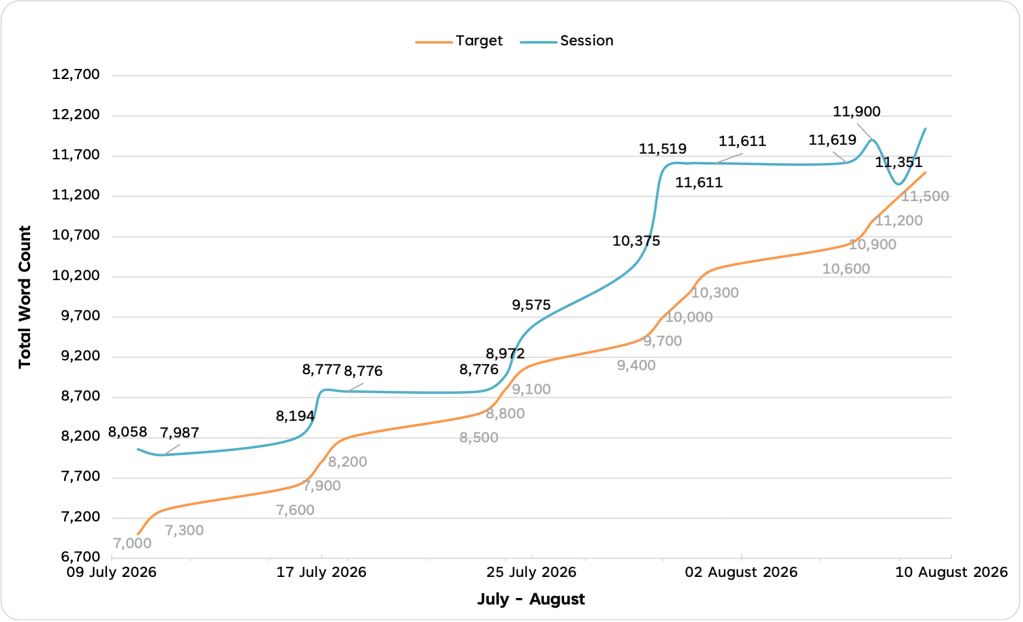
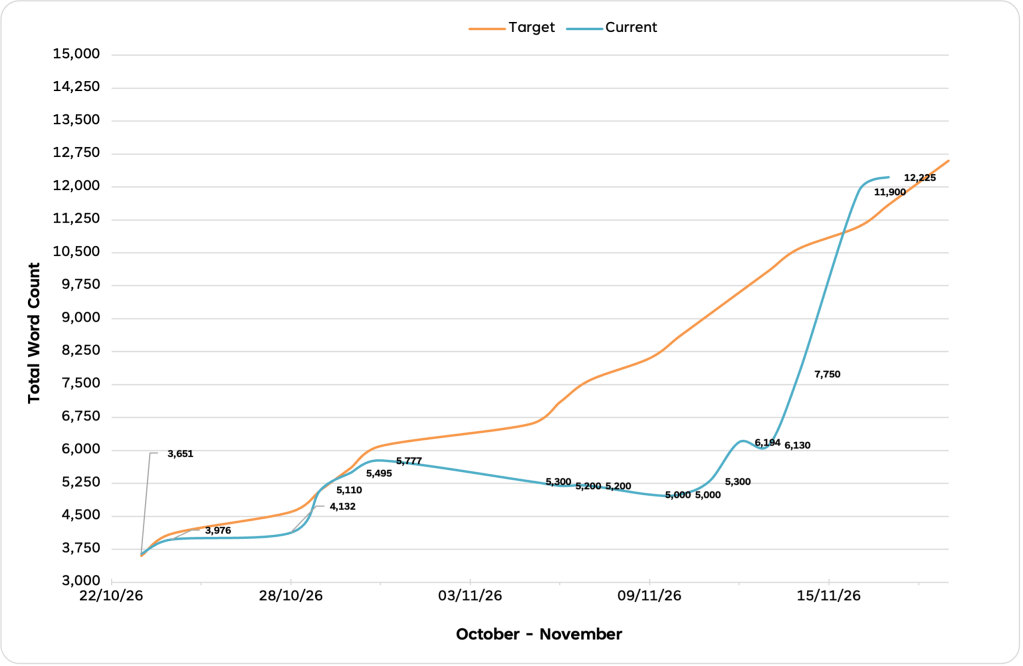
It feels good to see this progress, although it still feels like I have an enormous amount of work still to go. But slowly but surely, I’m doing this thing 🫡.
My current aim for submission is between June – September 2027. Wish me luck (and sanity), please!!
- Pat Thompson, 2019 https://patthomson.net/2019/02/11/tiny-texts-if-not-beautiful%E2%80%8B-small-is-pretty-darn%E2%80%8B-useful/ ↩︎
- Pat Thompson, 2019 ↩︎


Resonated? Leave a comment